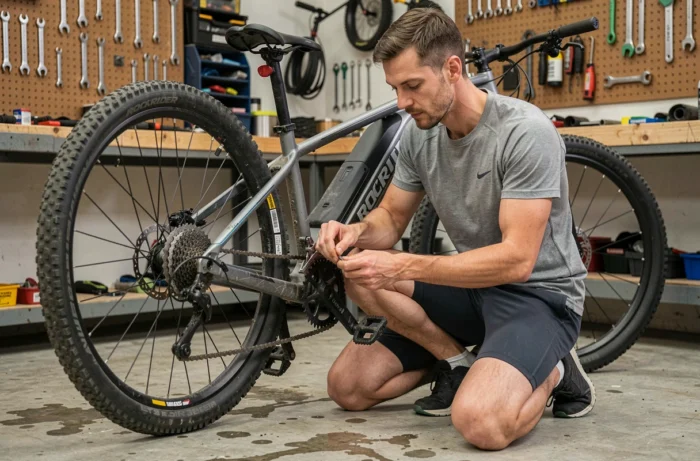
Your Rockrider E-ST 100 is exhibiting abnormal behavior: the assistance cuts out unexpectedly, the screen remains black, or the motor seems to brake instead of assist. Before rushing to a workshop or ordering an expensive part, a few simple checks can often help identify the source of the problem. Here’s a step-by-step method to diagnose a fault on this Decathlon electric mountain bike and make the right decisions.
Error codes on the Rockrider E-ST 100 screen: what they really mean
Have you noticed a number or letter flashing on your e-bike’s screen? This is not a display bug. Each error code points to a specific component: bottom bracket sensor, motor-controller connection, or battery voltage out of range.
The system embedded in the E-ST 100 uses a controller that continuously monitors the current delivered by the battery, the signal from the speed sensor, and that from the torque sensor (or rotation, depending on the version). When one of these signals goes outside the expected values, the assistance cuts out and a code is displayed.
Before looking further, note the exact code and the circumstances of its appearance: when cold, uphill, after going through water. These details help to diagnose a fault on the Rockrider E-ST 100 much more quickly than a simple random test.
A code that appears only under heavy load (climbing, strong headwind) points to a battery or connection issue. A code present from the moment of ignition suggests a disconnected sensor or a faulty controller.
The reflex that avoids most false alarms
Turn off the bike, remove the battery, wait about thirty seconds, then put it back in place. This simple reset clears temporary codes related to a micro-faulty connection. If the code returns immediately, the problem is hardware-related.
Loss of electric assistance on the E-ST 100: step-by-step diagnosis
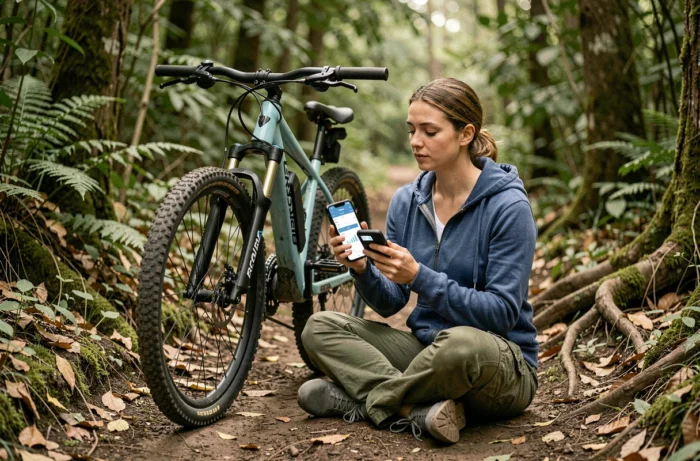
The most common scenario in user groups: the three levels of assistance hardly change, or the pedaling assistance disappears after a few minutes of riding. Two avenues to explore in order.
The bottom bracket sensor
On the Rockrider E-ST 100, a magnetic disc fixed on the bottom bracket axle sends a signal to the controller to indicate that you are pedaling. If this disc has shifted slightly, or if the sensor reading it has become loose, the assistance becomes erratic.
Check: turn the bike upside down, pedal by hand, and observe the screen. If the assistance symbol flashes or does not activate with each pedal stroke, the sensor is at fault. Realigning or replacing this small component is sufficient in most cases.
The motor-controller connection
Moisture, mud, and repeated vibrations on rough paths degrade the connectors. An intermittent faulty connection produces a typical symptom: the motor cuts out under load and then comes back on its own a few seconds later.
Inspect each accessible connector (motor output, controller input, speed sensor plug). Look for green oxidation on the pins. Cleaning with electronic contact spray and careful drying often resolves the issue.
- Rear motor connector: ensure it clips firmly, with no lateral play. A quarter turn may be enough to restore contact.
- Speed sensor cable (rear wheel): the magnet fixed on a spoke should pass a few millimeters from the sensor. A bent spoke or a displaced magnet distorts the reading.
- Battery plug: the terminals should be clean and dry. Any whitish trace indicates oxidation that needs to be addressed.
Rockrider E-ST 100 battery: distinguishing normal wear from a real failure
The battery concentrates most concerns, and for good reason: it is the most expensive component to replace. Before concluding that it is dead, ask yourself a simple question: has the range gradually decreased over several months, or suddenly dropped from one ride to the next?
A gradual decrease is a sign of normal cell aging. After several hundred charge cycles, any lithium-ion battery loses capacity. Tire pressure also plays a role that is often underestimated: on the E-ST 100, Decathlon recommends inflation between 1.0 and 1.8 bar. Under-inflated tires increase rolling resistance and put more strain on the battery, which reduces perceived range without indicating a fault.
A sudden drop, on the other hand, points to a faulty cell module or a defective BMS (the internal management circuit). In this case, the battery may show a full charge and then drop to zero within minutes.
Right to repair: what changes for e-bike batteries
Since July 2026, a specific right to repair for electric bike batteries applies in Europe. Manufacturers can no longer block technically feasible repairs through software. In practice, before accepting a quote for a complete battery replacement, you can ask if a BMS refurbishment or partial cell replacement is possible. This option often costs much less than a new battery.
Note: starting in February 2027, new e-bike models must include removable and user-replaceable batteries. If you buy an E-ST 100 today, check the ease of battery removal, a criterion that will impact resale value.
Motor locking while riding: identifying overheating on the E-ST 100
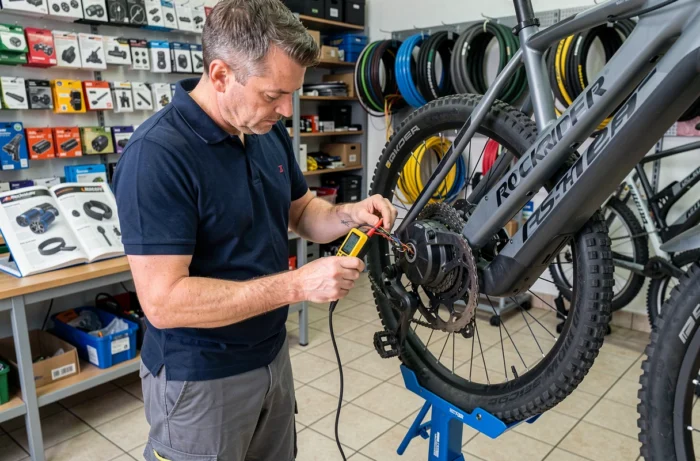
A frequent report on forums dedicated to the Rockrider E-ST 100: after about twenty minutes of sustained effort, the motor seems to lock up. The cyclist stops pedaling, waits, and everything resumes normally.
This behavior corresponds to a thermal protection cut-off of the motor. The controller detects excessive temperature and cuts off power to prevent damage to the windings. This is not a fault; it is a safety feature.
Exacerbating factors are cumulative:
- Prolonged use in maximum assistance mode on steep inclines.
- High outside temperature, particularly above 30 °C.
- High total weight (cyclist, equipment, load) forcing the motor to deliver more torque.
Reducing the level of assistance on long climbs and alternating with pedaling without assistance helps keep the motor within its normal operating range. If the cut-off occurs within the first few minutes and on flat terrain, the problem likely comes from the internal temperature sensor of the motor, which then requires a visit to the workshop.
The diagnosis of an e-bike always follows the same logic: start from the visible symptom, check the simplest elements (connections, tire pressure, reset), and then move up to the technical components. On the Rockrider E-ST 100, most common faults can be resolved without specialized tools, provided you know where to look.