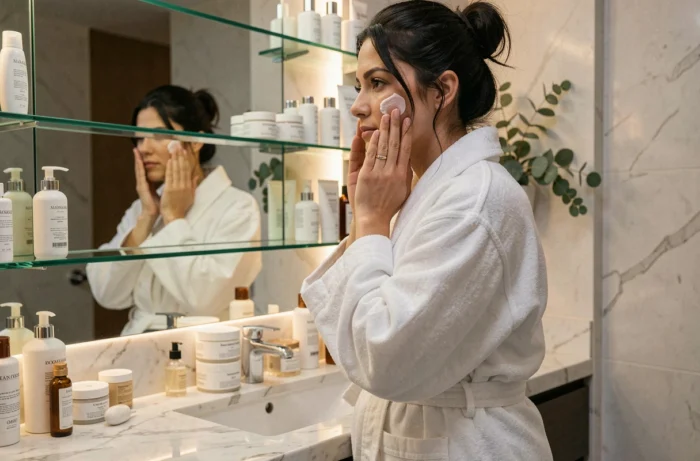
A beauty routine is based on a simple principle: adapting each action to the actual needs of the skin rather than multiplying products. Skin type, season, sun exposure, and even the quality of tap water directly influence the effectiveness of daily skincare. Understanding these variables allows for the creation of a coherent beauty routine, without waste or skin overload.
Skin streaming: the minimalist facial routine that changes the game
For several months, skin streaming has been making its mark in specialized media as an alternative to ten-step routines. The principle revolves around three products: a gentle cleanser, a hydrating serum that supports the skin barrier, and daily sun protection.
This minimalist approach stems from a dermatological observation: layering too many active ingredients on the face weakens the hydrolipidic film. Exfoliating acids, retinol, vitamin C, and niacinamide applied on the same evening often cause irritations that are mistakenly attributed to sensitive skin.
Reducing the number of products does not mean reducing effectiveness. A well-formulated serum, chosen according to skin type, effectively replaces three serums used in random alternation. Skin streaming requires selecting versatile products rather than stacking single-active products without logic.
To delve deeper into this approach and find suitable guidelines for each skin profile, beauty tips on Babioles Beauté detail coherent combinations of care based on facial needs.

Daily sun protection: why it’s the most underestimated anti-aging care
Sunscreen remains the beauty product with the most documented impact on skin aging. UV rays accelerate collagen degradation and cause pigmentation spots, even on cloudy days or behind an office window.
New European standards for SPF testing
In December 2024, the standard EN ISO 23675:2024 was published to measure the sun protection factor using in vitro methods. A European campaign confirmed a high correlation between these laboratory tests and traditional tests on volunteers. Another standard, ISO 23698:2024, allows for measuring SPF, UVA protection, and critical wavelength through diffuse reflectance spectroscopy.
These developments are changing the manufacturing of sunscreen products. Testing is becoming more ethical as it is no longer necessary to induce sunburns on volunteers. They are also faster and less expensive, facilitating the market introduction of day creams that incorporate reliable SPF.
For the daily routine, this means that moisturizers with integrated SPF now undergo more rigorous controls. Choosing a day cream with sun protection validated by these new standards ensures real UV coverage, not just marketing claims.
Applying sunscreen correctly
The amount applied determines the actual effectiveness of the product. Most users apply too thin a layer, which divides the actual level of protection.
- For the face, the recommended amount corresponds to about two lines of product on the index and middle fingers, spread over the forehead, cheeks, nose, and chin
- The neck and décolletage are often forgotten, even though they experience the same exposure as the face
- Reapplication every two hours remains necessary in cases of direct exposure, even with a high SPF

Facial cleansing: adapting the method to skin type
Cleansing is the action that conditions all subsequent steps. A poorly cleansed face cannot properly absorb a serum or moisturizer. An overly stripped face produces more sebum to compensate.
Double cleansing is suitable for makeup-wearing or urban pollution-exposed skin. It involves first using an oil-based product (cleansing oil or balm) to dissolve makeup and sunscreen residues, followed by a water-based cleanser to remove any remaining impurities.
For dry or reactive skin, a single gentle cleanse in the evening is often sufficient. In the morning, a simple rinse with lukewarm water or a swipe of toner preserves the hydrolipidic film reconstituted overnight.
Choosing a cleanser based on skin type
Oily skin tolerates foaming gels with a slightly acidic pH better. Normal to combination skin should opt for milks or micellar waters without alcohol. Sensitive skin requires formulas without fragrance and without aggressive surfactants like sodium lauryl sulfate.
The pH of the cleanser directly influences the balance of the skin’s microbiome. A product that is too alkaline disrupts the skin’s protective bacterial flora and promotes dryness or breakouts.
Hydration and serum: the application order that makes a difference
Applying products in the correct order is not a cosmetic detail. The rule is based on texture and molecule size: the most fluid formulas penetrate first, while the richer ones seal in hydration last.
Specifically, the effective sequence is as follows:
- Serum (concentrated active molecules, watery texture) applied directly after cleansing on slightly damp skin to enhance absorption
- Moisturizer (richer emulsion) that forms an occlusive barrier retaining water and the serum’s actives
- Sunscreen as the last step in the morning, applied over the cream, never mixed with it
In the evening, the night cream replaces the sunscreen. Young skin without specific issues can skip the serum and limit itself to a cleanser followed by an appropriate cream. It’s better to have two well-chosen products than five products applied without coherence.

The trend towards skin streaming confirms what dermatologists have long been repeating: consistency matters more than complexity. A routine of three products suited to one’s skin type, maintained over several weeks, produces visible results that no impulsive purchase of a miracle product can match. The one action that should never be neglected, regardless of the season or the duration of the routine, remains daily sun protection.