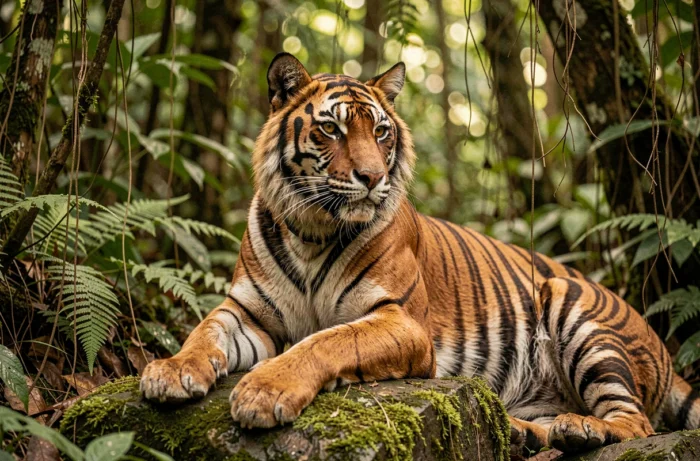
In the field, when observing a natural environment, it quickly becomes apparent that the species we thought were well identified still hold surprises. The diversity of animals is not limited to large mammals or colorful birds: it also plays out in taxonomic corners where a single supposed species hides five. This reality, confirmed by the latest scientific publications, changes the way we approach conservation and the understanding of life.
Leopardus tilcayo: when taxonomy redraws the map of felines
In September 2026, the journal Current Biology published the official description of Leopardus tilcayo, a small wild cat endemic to the cloud forests of the Yungas in Bolivia. It is the first new living feline species described in over a century.
Smaller than a domestic cat and spotted, this feline is known only from two individuals, one of which lives in a sanctuary. It highlights how some species can exist right under our noses without us formally recognizing them.
This discovery is part of a complete revision of the “tiger cats” group. What was considered a single species, Leopardus tigrinus, actually corresponds to at least five distinct species of South American small cats.
Among them: Leopardus pardinoides (Andean cloud forests, elevated to species status in 2024), Leopardus emiliae (Brazilian Caatinga and Cerrado), and Leopardus guttulus (Mata Atlântica). By cross-referencing molecular data and museum collections, one can find all species on Univers Animaux to appreciate the extent of this revised feline biodiversity.
New animal species described each year: a continuous flow
One might think that the golden age of zoological discoveries belongs to the past. Opinions vary on this point depending on taxonomic groups, but the flow of new descriptions remains steady.
Between 2022 and 2026, remarkable species were formally described across very diverse groups. Here are a few examples that illustrate this diversity:
- A giant isopod from the deep sea resembling Darth Vader, identified in the abyss and published in recent scientific literature.
- A snake with a turned-up nose, discovered in a tropical forest area, which surprised herpetologists with its atypical morphology.
- The Leopardus tilcayo, the first new feline described in over a century, spotted in the Bolivian Yungas.
These descriptions are not anecdotal. They show that terrestrial and marine biodiversity remains largely under-inventoried, particularly in tropical forests, deep reefs, and karst areas.
Animal behaviors: what recent research decodes
Beyond taxonomy, animal behaviors themselves reveal operational discoveries for conservation. For example, a study published in Biology Letters shows that the North Pacific sperm whale has altered its behavior in response to whalers since the 19th century. These cetaceans have begun to swim quickly and against the wind to escape ships, a strategy different from that used against their natural predator, the orca.
They have passed this adaptation on to subsequent generations. This is not a simple reflex of flight: it is a social learning documented over several decades.
Another concrete case: recent research on birds shows that some species, like the regent honeyeater in Australia, are gradually losing the ability to sing correctly. When the population of a species drops too low, young males no longer have enough tutors to learn their song. The direct result: a cultural impoverishment that jeopardizes reproduction.
Cephalopod intelligence and fish personality
Octopuses continue to demonstrate cognitive abilities that challenge our understanding of animal intelligence. Cephalopods solve problems, use tools, and exhibit individualized behaviors.
On the fish side, research confirms that each individual has its own personality, with stable behavioral differences in response to risk, exploration, or sociability. These findings change the game for population management in natural environments and aquaculture.
Species protection: where do we stand concretely in 2025
In terms of conservation, data compiled by Map of Life indicate that species protection has progressed by 6% on land and 4% at sea in 2025. At COP16, the interim assessment showed that half of the global species protection goals were being met.
These figures do not mean that the situation is resolved. They indicate a trajectory, not a final result. The areas richest in undiscovered species, such as Andean cloud forests or deep coral reefs, often remain outside protected areas.
- Humid tropical forests concentrate the majority of still undiscovered species, particularly among arthropods and amphibians.
- Deep marine environments remain the least inventoried, with very low scientific coverage rates.
- Fragmented habitats (cerrado, caatinga) host endemic species whose taxonomic revision is ongoing.
Artificial intelligence and animal communication
A final area of research deserves attention. Recent work uses artificial intelligence to decode animal communication. These tools analyze vast volumes of vocalizations and behavioral signals to identify recurring structures. We are not yet at the point of “translating” dolphin language, but progress is already allowing for a better understanding of the contexts in which certain signals are emitted among primates and cetaceans.
Animal diversity is not just a catalog of species. It encompasses transmitted behaviors, real-time adaptations, and taxonomic revisions that reshape what we thought we knew. Each new species description alters conservation priorities, and each decoded behavior sharpens our ability to protect declining populations.