The fashion market is undergoing a period of accelerated change. Between the adoption in France of a law targeting ultra-fast fashion and the increasing power of European regulations on textiles, clothing choices are no longer just about aesthetics. The autumn-winter fashion trends and daily style tips are now viewed through a dual lens: what is worn and how the legal framework alters consumption patterns.
Displayed place of manufacture: a new criterion for choosing fashion pieces
The French law on ultra-fast fashion introduces an obligation that fashion advice articles rarely mention: the display of the place of manufacture near the price for textile products sold online. This measure transforms a piece of information previously buried in labels into a prominent detail.
For those building their wardrobe season after season, this change has a direct consequence. The country of manufacture becomes a comparison filter just like the cut or color. A pair of jeans made in Portugal and a pair produced on the other side of the world are no longer distinguished solely by price: the origin is displayed, and the consumer decides.
Brands that focus on European manufacturing see it as a differentiation lever. To delve deeper into this angle and explore other ways to structure a thoughtful wardrobe, fashion articles on Le Temps qu’il Faut regularly address the issue of sustainable style without sacrificing elegance.
Autumn-winter trends: what the runways translate into daily wardrobes

The women’s trends for the cold season confirm a movement that has been underway for several seasons: versatile pieces are taking precedence over impulsive purchases. The oversized sweater, barrel jeans, and muted colors (butter, terracotta, deep burgundy) return to collections without any disruptive effect.
What changes is the way these pieces are assembled. Autumn-winter looks gain coherence when each element can work in multiple outfits. A colorful cropped jacket worn over beige pants on Monday can be paired with a midi dress on Friday. The versatility of a piece determines its place in the wardrobe far more than its alignment with a seasonal color.
Pink, announced as the key color for spring-summer, extends its presence in a powdered version for autumn. Pastel tones migrate to heavier textures (thick knits, corduroy), making them wearable for a longer period. This continuity between seasons reduces the need to refresh the wardrobe with every transition.
Building a daily outfit around three axes
- The structural base: a well-cut pair of jeans (barrel or straight), neutral canvas pants, a midi skirt. These pieces absorb style variations without imposing a tone
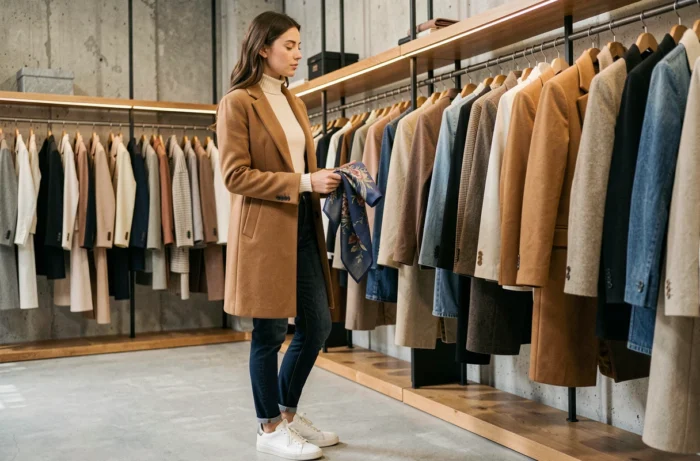
- The statement piece: a short trench coat, a patterned sweater, a colorful jacket. One strong element per outfit is enough to define a style without overloading the look
- The calibrated accessories: a belt, a medium-sized bag, flat or moderately heeled shoes. Accessories anchor the silhouette in a register (casual, urban, dressed) without requiring changes to the main pieces
Anti-fast fashion law and fashion advice: what changes concretely
The French law does not merely display the origin. It provides for a financial penalty mechanism for brands involved in ultra-fast fashion. The contributions paid by these producers increase, and part of these funds is directed towards collection, sorting, reuse, and recycling infrastructures.
The text also plans to ban advertising for ultra-fast fashion products, including that done by influencers. The exact thresholds for definition are still to be determined by implementing texts, which means that the list of affected brands has not yet been finalized. Presenting any specific name as already targeted would be premature.
For consumers, the most tangible consequence concerns promotional offers. Aggressive sales campaigns associated with certain online platforms may disappear or become rarer. This reshapes how purchases are planned: investing in durable pieces becomes both an economic calculation and a style choice.
Circular fashion as an extension of style advice
Reuse and second-hand are no longer marginal practices. The European framework increases pressure on the sector by allowing contributions to be adjusted based on the estimated lifespan of products and their potential for reuse. A garment designed to last will cost less to produce in terms of contribution than a disposable product.
Translating this mechanism into daily fashion advice means prioritizing materials that are resistant to washing, cuts that do not go out of style in six months, and finishes that hold up. The weight of a fabric, the quality of seams, and the durability of dyes become criteria as relevant as the current color trend.
Adapting trends to one’s morphology without multiplying purchases
Style guides often recommend buying according to one’s morphology. The advice remains valid, but its application changes when intersected with a logic of a reduced wardrobe.
- Identify two or three cuts of pants that work for your silhouette, then stick to them regardless of the season. Barrel jeans suit A-shaped bodies, while straight pants fit H-shaped silhouettes
- Test trendy colors in accessories before investing in a key piece. A pink scarf or a butter yellow bag costs less than an entire coat in a shade that won’t withstand visual wear
- Favor natural materials or blends with a majority of natural fibers, which perform better over washes and adapt to temperature variations between seasons
Three well-chosen pieces replace ten seasonal purchases. This is not a minimalist slogan; it is a practical observation: fewer failed combinations in the morning, fewer clothes relegated to the back of the closet after two months.
Fashion trends and style advice converge in the same direction: buy less, choose better, wear longer. The French and European regulatory framework accelerates this movement by making visible information (origin, durability) that has remained secondary until now. Daily style is now built as much on aesthetic choices as on consumption decisions.