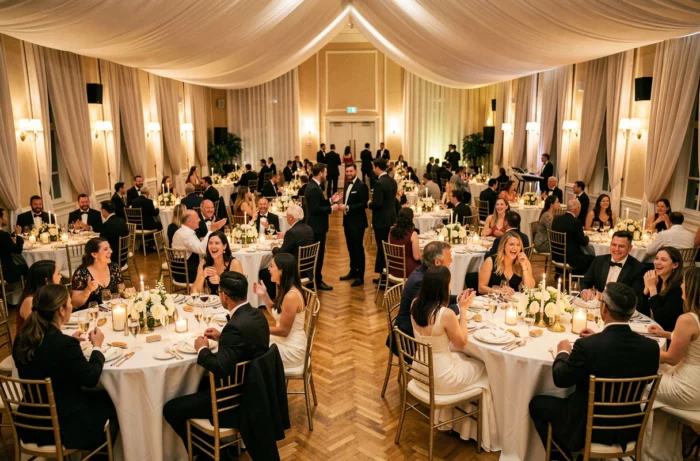
Animating a wedding meal without disrupting the flow of service requires precise calibration. Short formats, ideally limited to about ten minutes between courses, work better than long sequences that freeze the room. We recommend coordinating each animation with the caterer and the DJ to avoid dead time. Here are ten concrete ideas for a lively wedding meal, tested in the field.
1. Close-up magic from table to table
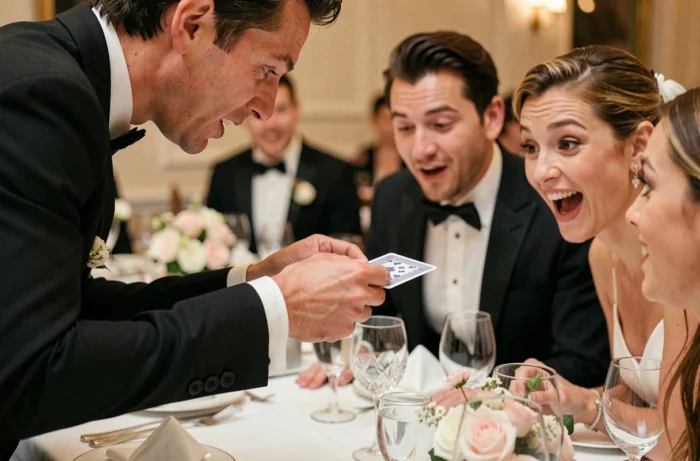
A close-up magician circulates between tables during the service, with sequences lasting three to four minutes per group. This format requires no stage, no microphone, and does not disrupt the serving of dishes.
The effect relies on proximity. Card tricks, coin tricks, or mentalism performed less than a meter away from guests create a chain reaction: the neighboring table requests their turn. We observe that this animation works particularly well during the wait between the starter and the main course, when guests’ attention wanes.
You can find wedding tips on Info Mariage to articulate this type of intervention with the rest of the evening.
2. Live cooking station integrated into the menu
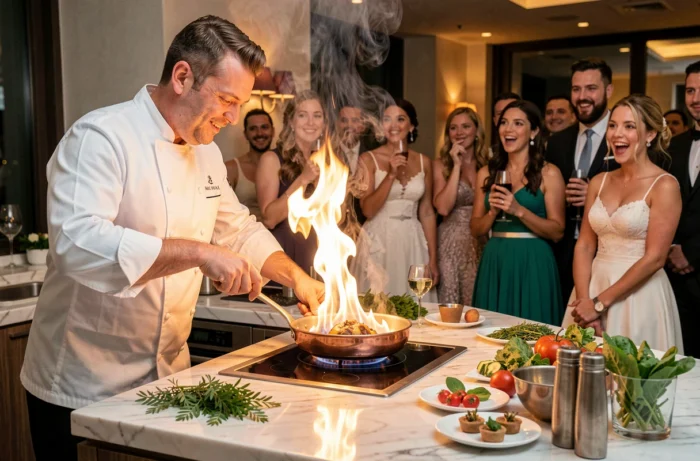
Interactive culinary animation is gaining momentum in recent weddings. The principle: a chef prepares a dish or finishes it in front of the guests, live. Flambéing a dessert, carving a piece of smoked meat, assembling makis at the table.
The cooking station is both entertainment and service, eliminating the issue of downtime between courses. Guests participate visually and sometimes manually (choosing garnishes, seasoning). The caterer must validate the setup in advance for heat and ventilation constraints.
3. “Her or Him” quiz in instant duel mode
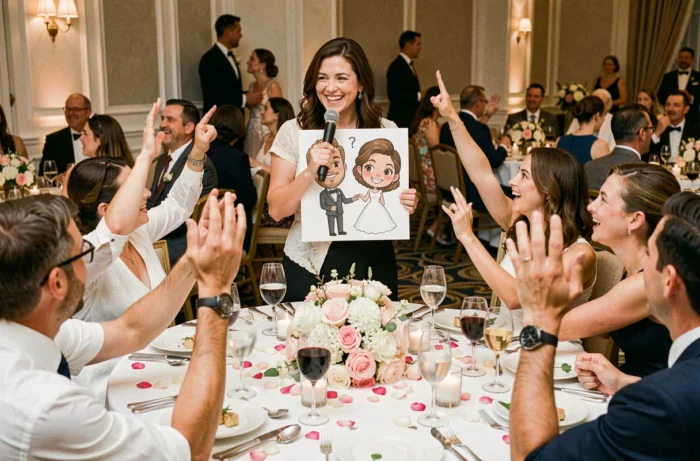
The “Her or Him” quiz remains a classic, but its effectiveness entirely depends on the quality of the questions. Clichéd questions (“who cooks better?”) fall flat. Questions that work revolve around acknowledged disagreements, unconfessed habits, and the couple’s secret plans.
To keep the format under ten minutes, we recommend a maximum of eight to ten questions, with a master of ceremonies who controls the pace. Contradictory answers between the couple produce the peak energy in the room.
4. Musical blind test based on the couple’s story
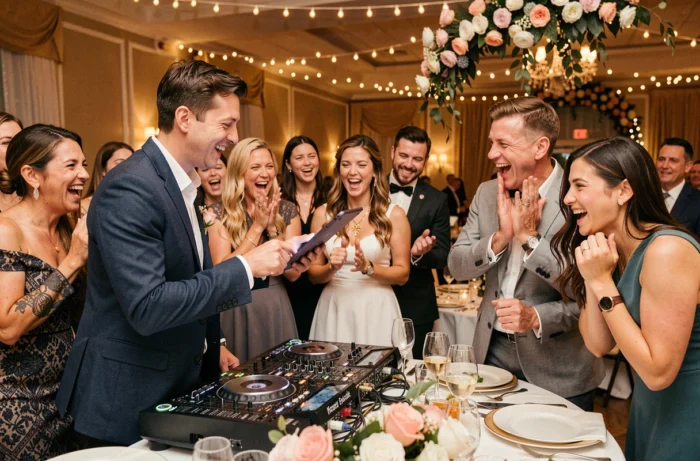
The classic table blind test works, provided the playlist is personalized. Each excerpt corresponds to a key moment in the couple’s relationship: song from the first date, soundtrack from the engagement trip, a song played on repeat during the preparations.
The DJ plays excerpts lasting fifteen to twenty seconds. Tables respond with slates or via a smartphone app. A personalized blind test is a better replacement for a generic blind test because it tells a story that only close friends can guess.
5. Table challenges with secret missions
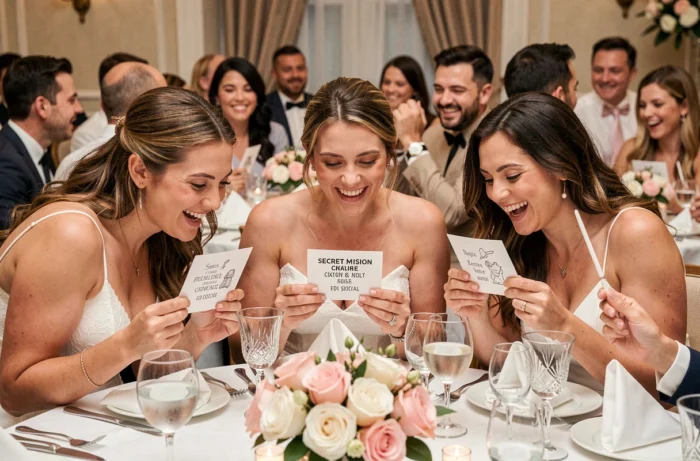
Each table receives a sealed envelope at the beginning of the meal containing a mission to complete before dessert. The missions vary in difficulty:
- Get a guest from another table to sing without revealing the mission
- Obtain a group photo with the couple in a posed setting
- Compose a four-line poem and read it into the microphone before the cake
- Swap a guest with another table for an entire course without the couple noticing
The results are revealed at the end of the meal, with a vote for the best execution. This format structures the evening without interrupting the service, as the missions take place alongside the courses.
6. Guests’ time capsule
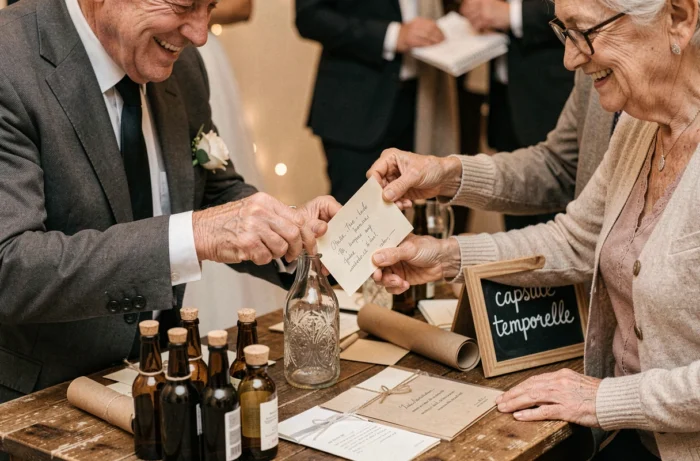
A sealed box circulates during the meal. Each guest slips in a note, a wish, a prediction, or a Polaroid photo taken on the day itself. The couple opens the capsule on a set date (first anniversary, five years).
The time capsule works continuously without mobilizing collective attention. It passes from table to table during the meal, accompanied by pre-printed cards with sentence starters to avoid blank page syndrome.
7. Collective mural as a guestbook
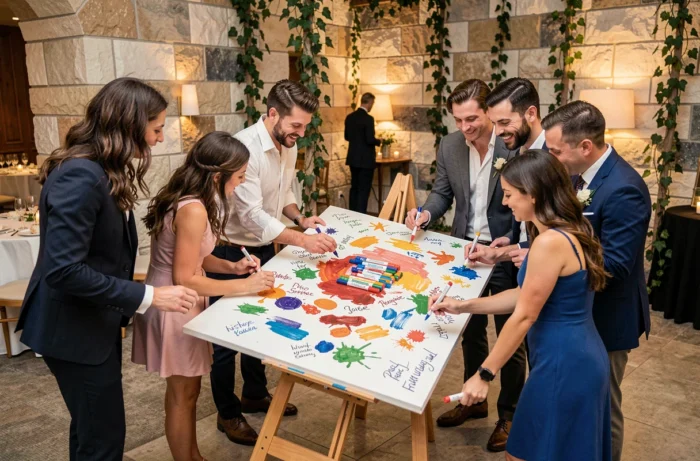
An easel with a large canvas replaces the traditional guestbook. Markers, acrylic paint, and stencils are provided. Guests contribute between courses, without timing constraints.
The result produces a unique piece of art that the couple hangs in their home. To ensure the canvas doesn’t remain blank, it’s essential to kickstart the movement early: ask the witnesses to start during the cocktail hour.
8. Surprise karaoke between courses
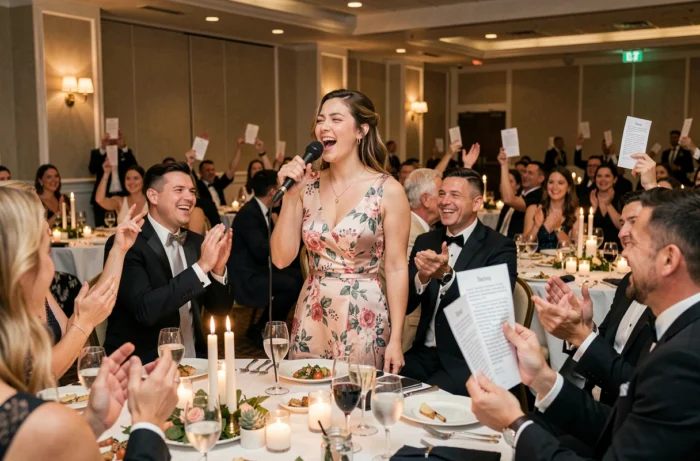
Karaoke works in a flash format: only two or three songs, launched between the main course and dessert. Participants are designated in advance by the witnesses, with songs chosen for their comedic or emotional potential.
The classic mistake is to leave karaoke as a free-for-all. Without framing, it drags on and loses the room. A maximum of three performances, imposed songs, total duration under ten minutes.
9. Photo challenge with a theme imposed by table
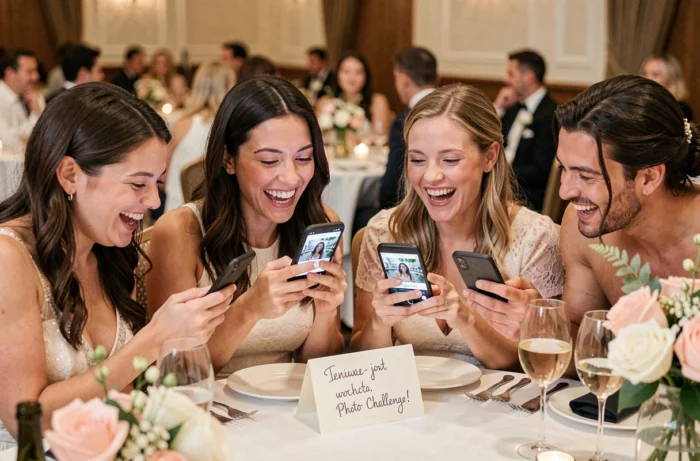
Each table receives a photographic theme to interpret: reenacting a movie scene, human pyramid, quirky family photo. The shots are sent to a shared thread or projected live on a screen in the room.
This format engages guests without interrupting the meal. The real-time projection creates excitement between tables and produces usable memories for the wedding photo album.
10. Narrative thread led by the master of ceremonies
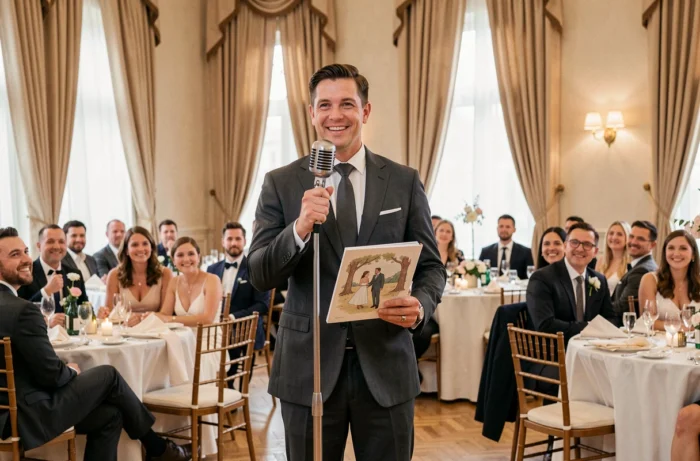
The narrative thread is an animation divided into micro-sequences spread throughout the meal. The master of ceremonies returns between each course with a new episode: an anecdote about the couple, an express challenge, a revelation, a show of hands vote.
This format avoids the pitfall of a “block animation” lasting thirty minutes that cuts the meal in two. Each intervention lasts a few minutes and revitalizes the room’s energy at the right moment. Coordination with the caterer is necessary to align the interventions with service transitions.
Animating a wedding meal is based on a simple principle: short, well-distributed formats coordinated with the service. It’s better to have three well-executed animations than an overloaded program that exhausts guests before the dance floor.