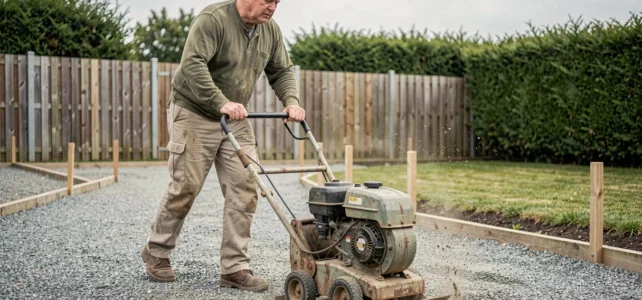
A gravel spread to a uniform thickness and compacted with a vibrating plate does not always compact properly. The problem rarely lies with the tool or the number of passes. It comes from the material itself, its grain size, its moisture content at the time of compaction, or the sequence of implementation. Here we detail the technical points that make the difference between a stable base and a layer that continues to shift under traffic.
Gravel that does not compact: diagnosis before resuming passes
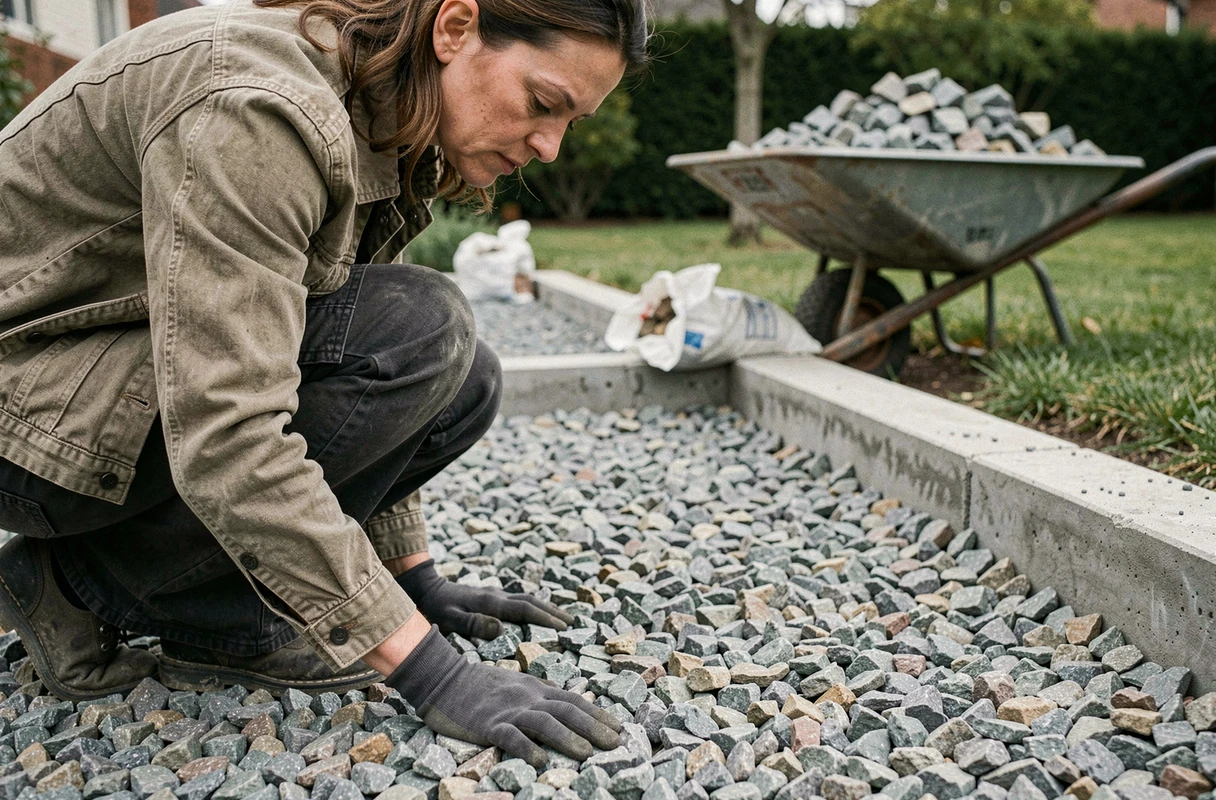
A rolled gravel, even when properly moistened, never interlocks as well as crushed gravel. The sharp edges of crushed gravel create angular contact points that lock together under the effect of vibration. Rolled gravel, on the other hand, rolls, and each pass of the vibrating plate moves the grains instead of locking them in place.
If compaction does not take after three or four passes, we recommend checking three parameters before continuing.
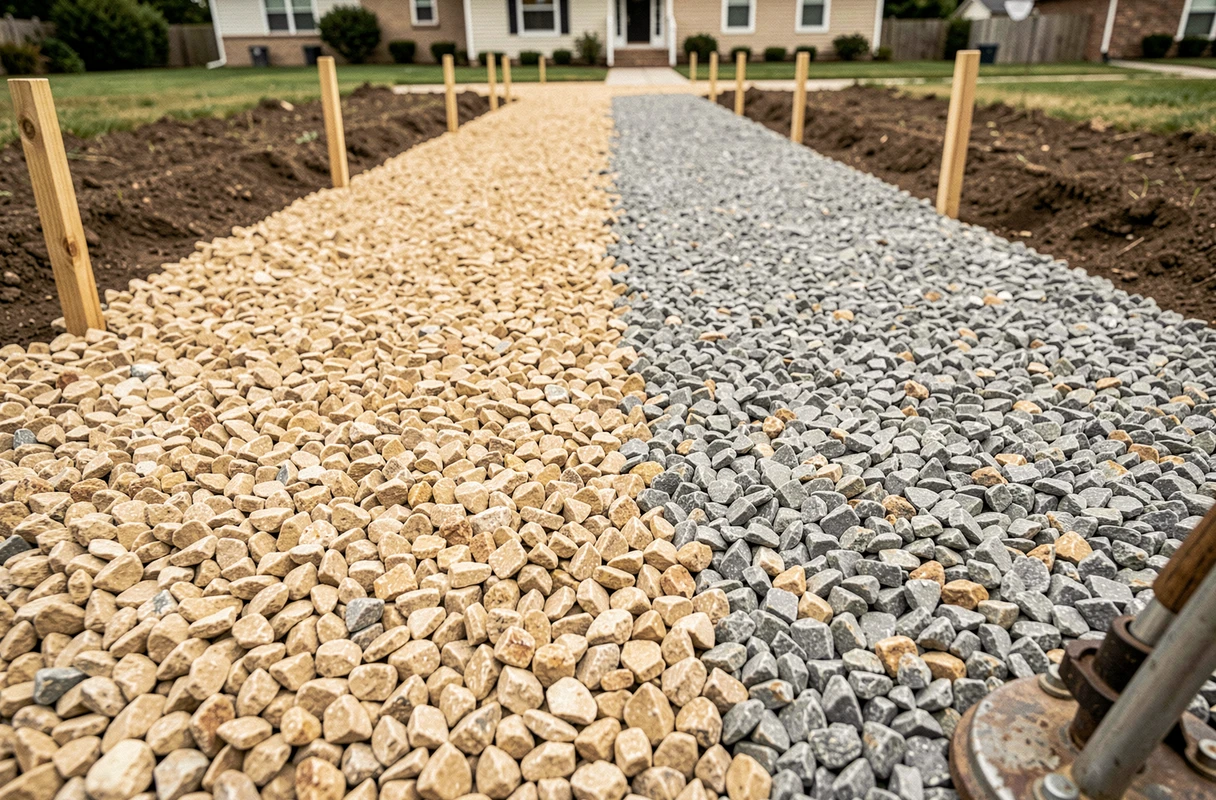
- Grain size: a material that is too uniform (single grade, type 6/10 or 10/14) leaves too much void space. A mix of 0/31.5 or a natural gravel containing fines compacts significantly better than a single-grade decorative gravel.
- Moisture: the material should be slightly moist, never saturated. An excess of water prevents air from escaping between the grains and creates a hydraulic lift effect that cancels out the vibration. Conversely, soil that is too dry lacks cohesion among the fines.
- Layer thickness: beyond a certain thickness in a single pass, the vibrating plate no longer transmits its energy to the bottom. We will return to this in the next section.
When the material is unsuitable (pure rolled gravel, single grade without fines), no compactor will compensate. The solution involves partial replacement or the addition of limestone fines to fill the voids and allow for interlocking.
To delve deeper into these aspects, several tips for compacting gravel help better frame the choice of material before the project begins.
Compaction in successive layers: thickness and number of passes
Each layer must remain thin enough for the vibrating plate to work throughout the depth. In practice, a common construction plate effectively compacts layers of about fifteen to twenty centimeters. Beyond that, the lower part remains loose, even if the surface feels firm to the touch.
The logic is that of backfilling in successive passes: spread, level, compact, then repeat. On a driveable path that requires a thick base, we systematically apply this method rather than a one-time fill.
Cross passes for uniform density
Compacting always in the same direction creates longitudinal weak lines. Cross passes, alternating the direction with each series, distribute the compaction energy more evenly. After a first series in the lengthwise direction, the next series is done perpendicularly. Checking the flatness between each series allows for identifying areas that sink more and correcting before the next layer.
On small surfaces, a manual roller or hand tamper may suffice. On a parking lot or a driveway wider than a few meters, the vibrating plate remains the reference tool. The compactor roller is more suitable for large roadway surfaces.
Edge zones and work edges: the weak point of gravel compaction
Popular articles describe compaction as a surface operation. In reality, the edges concentrate the majority of issues on gravel paths because the vibrating plate cannot lean against an edge without risking destabilizing the border itself.
On the periphery, the vibrating plate loses some of its effectiveness: energy dissipates laterally instead of descending vertically. The result is a soft band of a few centimeters along the edges, which sinks under traffic.
Manual work on the edges
We treat these areas with a manual tamper or a rammer, insisting with close impacts. Compacting the edges before placing the final borders prevents later detachment. If the borders are already in place, work must be done as close as possible without hitting them, even if it means adding a complement of fines and tamping in a very thin layer.
Geotextile, drainage, and long-term stability of compacted gravel
Compaction alone does not guarantee the longevity of the structure. Without geotextile between the supporting soil and the gravel layer, the fines from the natural ground migrate upwards due to freeze and rain cycles. The gravel eventually sinks into the supporting soil, and the surface deforms.
The geotextile serves two functions: it separates the layers (anti-contamination) and filters water without retaining fines. A sufficiently dense weight is recommended for a trafficked path. For a simple pedestrian walkway in a garden, a lighter weight is sufficient.
Drainage and water management under the compacted layer
Well-compacted gravel remains permeable, which is one of its advantages over a concrete slab. The condition is not to clog the surface layer with an excess of fines. If the supporting soil is clayey and poorly draining, a foundation layer of larger gravel, placed under the geotextile, allows for water to drain before it stagnates under the gravel.
On sloped terrain, compaction must be accompanied by sufficiently anchored borders to contain the gravel. Without lateral retention, gravity and runoff gradually move the material toward the low point, regardless of the level of compaction achieved.
The stability of a gravel driveway thus relies on a coherent set: crushed material with fines, thin layers compacted in cross passes, manually treated edges, suitable geotextile, and drainage considered from the design stage. Neglecting even one of these parameters is enough to compromise the result, even with a high-performance compactor.