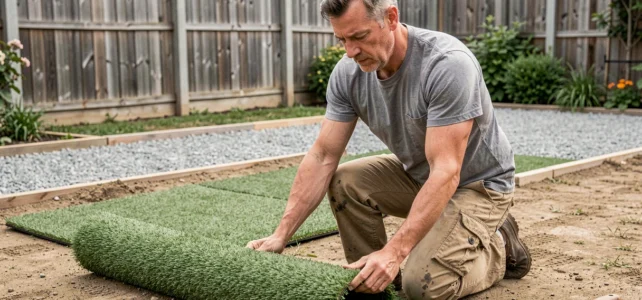
Transforming a patch of garden into a green and tidy area, without watering or mowing, is the promise of synthetic grass laid on soil. The result depends less on the chosen product than on the soil preparation. A poorly leveled or poorly drained area causes wrinkles, puddles, and accelerated aging within a few seasons.
Drainage and slope: what determines the longevity of your synthetic grass
Before thinking about the roll of artificial turf, take a look at your land after heavy rain. Have you noticed areas where water stagnates for more than an hour? These pockets of moisture are the first enemy of a durable installation on soil.
Clay soil retains water much more than sandy soil. If your land is compact and water takes time to seep in, you will need to excavate further and add a thicker drainage layer. Conversely, naturally draining soil simplifies the work.
A slope of a few centimeters per meter is enough to drain rainwater away from the surface. This slope is created during leveling, before any other step. Without it, even a quality geotextile will not compensate for ground that retains moisture under the grass.
A detailed guide explains precisely how to lay synthetic grass on soil while respecting these drainage constraints from the soil preparation stage.
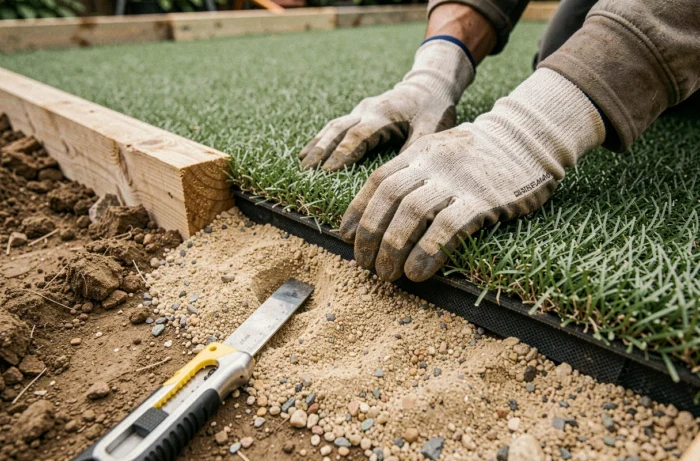
Preparing the soil on soil: compaction and geotextile
Preparing the ground takes up most of the working time. A rushed installation at this stage will show in a few weeks, with visible ripples or depressions.
Excavate and clean the surface
Remove all existing vegetation, including roots. Weeds that regrow under synthetic grass create unsightly bumps. Excavating a few centimeters allows for the placement of the sand layer and geotextile without raising the final surface compared to adjacent borders or terraces.
Level with compacted sand
Crushed sand (like quarry sand or fine all-in-one) provides a stable base after compaction. Spread it evenly and use a roller or vibrating plate to achieve a firm surface.
The ground must be hard underfoot, not loose. If you sink while walking on it, it needs more compaction. Insufficiently compacted soil deforms under the weight of garden furniture or repeated foot traffic.
Lay the geotextile over the entire surface
The geotextile serves two functions: blocking the regrowth of weeds and separating the sand from the grass. It is laid out over the entire area, with an overlap of a few centimeters between the strips. Secure it with metal staples so it doesn’t move during the grass installation.
Why not skip this step? Because without geotextile, weeds will penetrate the synthetic grass within a season, even on previously treated soil.
Installation and joints of synthetic grass on soil
Once the ground is ready, the installation itself primarily requires method and patience.
Unroll in the right direction
Unroll all the strips in the same direction. The fibers of synthetic grass have an orientation: if you lay two strips in opposite directions, the difference in reflection will be visible, especially in bright sunlight. Allow the grass to rest flat for a few hours so it can relax and lose the storage creases.
Cut and adjust the edges
Use a cutter with a new blade. Cut from the back of the roll, following the seams between the rows of fibers. Allow a few centimeters of margin along the walls and borders, then adjust as closely as possible in a second pass.
Create invisible joints
Well-made joints make the installation undetectable. Here are the points to follow to assemble two strips:
- Place a self-adhesive or glueable joining strip under the joint, centered between the two strips
- Fold each edge of grass over the strip, ensuring that the fibers slightly overlap without leaving empty spaces
- Brush the fibers at the joint to mix the strands of the two strips and mask the cut line
- Secure the whole with fixing nails approximately every twenty centimeters along the outer edges
Microplastics and synthetic grass: a point not to be ignored
Most installation guides go straight to maintenance without addressing the environmental impact. Synthetic fibers degrade over time, due to sunlight and weather conditions.
The European Chemicals Agency (ECHA) estimates that synthetic grass in Europe releases between 18,000 and 72,000 tons of microplastics per year, mainly through fiber degradation and migration of infill materials. These particles end up in soils and waterways.
What can you do concretely during the installation on soil? Carefully confining the edges limits the dispersion of cut fibers. A quality geotextile under the grass also prevents particles from migrating deep into the soil. During cutting, systematically collect the scraps and fiber residues instead of leaving them on site.
Properly confining the edges and collecting scraps reduces the leakage of microplastics into your garden and beyond.
Common mistakes that ruin an installation on soil
Some mistakes recur regularly and are difficult to correct afterward:
- Laying synthetic grass directly on topsoil without excavating or compacting, which causes rapid deformation
- Neglecting the direction of laying the strips, creating visible shade differences between the bands
- Using beach sand (too fine, unstabilized) instead of crushed sand suitable for compaction
- Forgetting to weigh down or secure the edges along the walls, allowing the wind to lift the grass
Redoing a failed compaction or correcting leveling after installation means dismantling everything. It’s better to spend time on ground preparation than to have to start over.
Synthetic grass laid on soil easily lasts a decade when the ground is properly prepared. The least visible step, compacting the sand, is also the one that makes all the difference between a surface that remains flat and one that buckles after the first winter.