
The Piveteau HP+ pellets are among the most cited references on pellet stove forums in France. Their reputation is based on recognized certifications and Vendée manufacturing. It remains to be seen whether user feedback and technical data justify their pricing, which is significantly higher than that of other certified brands.
Ash content, calorific value, moisture: compared technical data
To evaluate wood pellets, three parameters capture the attention of stove and boiler users. The table below compares the characteristics claimed by Piveteau HP+ with the thresholds required by the DINplus and ENplus A1 certifications, which govern almost the entire premium market.
| Criterion | Piveteau HP+ | ENplus A1 Threshold |
|---|---|---|
| Calorific value | Above the minimum required by the standard | ≥ 4.6 kWh/kg |
| Moisture content | Less than 10% | ≤ 10% |
| Ash content | Reported very low, among the lowest in the segment | ≤ 0.7% |
| Fines content | Low due to packaging in film-wrapped bags | ≤ 1% |
Piveteau HP+ positions itself above the normative thresholds on each criterion. A particularly low ash content reduces the frequency of cleaning the burner, a point that many users highlight in their feedback.
The reviews of Piveteau pellets converge on the consistency of combustion and low production of clinker, two direct consequences of these technical characteristics.
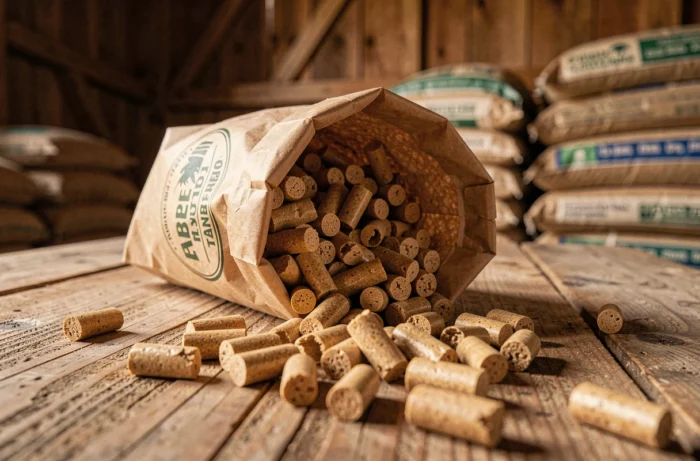
Piveteau pellets and pallet price: a premium above other premiums
The French market for certified pellets includes several high-end brands: Crépito, Woodstock, EO2. Piveteau HP+ pellets consistently fall within the high range of this already expensive segment. The observed price ranges in 2026 place the price of a premium pallet between 410 and 485 euros depending on the brand and region, with Piveteau regularly appearing at the top of this range.
This additional cost compared to other pellets also certified ENplus A1 raises a legitimate question. Is the combustion quality of Piveteau HP+ significantly better than that of a Woodstock or Crépito sold for several dozen euros less per pallet?
What the extra cost concretely finances
Piveteau Bois is a Vendée-based industrial company integrated into the French wood sector. Production relies on sawmill by-products (offcuts and sawdust), which limits the use of dedicated round wood. Packaging in 15 kg or 10 kg film-wrapped bags reduces moisture uptake during transport and storage.
However, these elements (short circuit, careful packaging, double certification DINplus and ENplus A1) are also found in some direct competitors. The price differential is not solely explained by the intrinsic quality of the pellet, but also by brand positioning and distribution network.
User feedback: recurring themes in specialized forums and groups
Discussions in Facebook groups dedicated to pellet stoves and wood heating forums highlight recurring trends. Three positive points dominate:
- The consistency from one batch to another: users notice little variation in quality between two pallets purchased several months apart, a common complaint directed at brands less rigorous in quality control
- The clean combustion with very little residue in the burner, which extends the intervals between two cleanings of the stove
- A low dust content at the bottom of the bag, indicating good mechanical stability of the pellets during transport
Critiques are almost exclusively about the price. Several users indicate that they have achieved comparable performance with cheaper brands, particularly Crépito or distributor pellets certified ENplus A1.
Piveteau or Crépito: a recurring debate
The comparison between Piveteau and Crépito comes up in almost every discussion thread. Both brands share identical certifications and similar technical characteristics. The perceived difference lies in qualitative consistency: Piveteau has a reputation for superior regularity, while Crépito, produced by multiple sites, may show variations depending on the factory of origin.
This point is difficult to verify objectively without independent laboratory analyses. User feedback remains subjective and depends on stove settings, flue quality, and storage conditions.
Market context for pellets in 2026: stabilization after the surge
After the price peak at the end of 2022, when prices exceeded historical levels, the French market for wood pellets has stabilized. Prices remain sustainably higher than before the energy crisis, which changes the consumer’s perspective.
In this context, the choice of a premium pellet like Piveteau is mainly justified for recent high-performance devices, where a consistently high-quality pellet protects the heat exchanger and the feeding system. For an entry-level stove, the price difference with a cheaper certified pellet rarely translates into a measurable gain in comfort or longevity.
The ENplus A1 and DINplus certifications guarantee a reliable quality baseline. Piveteau HP+ exceeds this baseline on several parameters, but the extent of this gap varies depending on batches and usage conditions. The decisive criterion for many buyers remains local availability and delivered pallet price, which fluctuates significantly from one region to another.