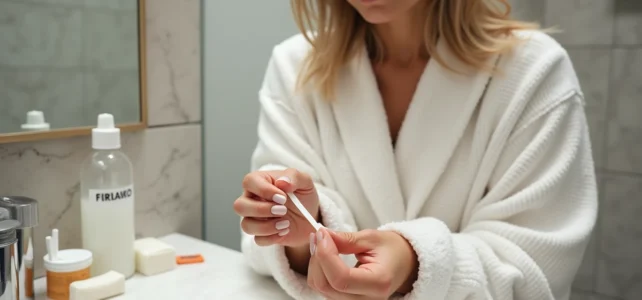
A torn nail, whether it’s after a bump against a door, a misaligned hammer strike, or a wrong move in sports, causes sharp pain and a lot of worry. The good news: in the vast majority of cases, the nail will fully regrow if initial care is properly administered. However, it is essential to avoid some common mistakes that slow down healing or increase the risk of infection.
Moist environment and gentle disinfection: two reflexes that change healing
Have you ever noticed that a wound left exposed forms a hard scab and pulls for days? This reflex of letting it dry is not the best for a torn nail. Current healing recommendations favor a moist environment around the nail bed, for example with a hydrocolloid dressing. This type of dressing maintains an environment conducive to tissue repair without drying them out.
Before applying this dressing, cleaning the wound is as important as the dressing itself. Warm water and mild soap are sufficient. A saline solution (physiological serum) works as well. On the other hand, hydrogen peroxide and alcohol damage exposed tissues and delay healing. These products, too aggressive for an open wound on the nail bed, destroy the cells that are in the process of repairing.
To properly treat a torn nail, the choice of disinfectant and dressing in the first few minutes makes a real difference in the quality of regrowth.
Elevating the finger after the impact: an underestimated gesture against pain

The throbbing pain after a torn nail largely comes from swelling. Blood flows to the injured area, pressure increases, and each heartbeat can be felt at the tip of the finger or toe.
Keeping the finger or toe above heart level during the first hours significantly reduces this swelling. Specifically: lie down and place your hand on a cushion, or elevate your foot on an armrest. This simple gesture also decreases the risk of developing a subungual hematoma (that dark spot under the remaining nail).
If the pain remains intense despite elevation and a large hematoma forms under the plate, a quick medical consultation allows for an assessment of the need to drain the pressure. An excessively large hematoma can compress the matrix and complicate regrowth.
What should never be glued on a traumatized nail
The first reflex after a partially torn nail is to want to glue it back. Cosmetic glue, adhesive tape, or a bandage stuck directly on the open area – these solutions seem logical but pose a real problem. Adhesives applied to the wound irritate the tissues and tear the cells that are healing when removed.
If the nail is still partially attached, the fixation should be done on the healthy skin around the wound, never on the exposed nail bed. Here are the most common mistakes to avoid:
- Applying false nail glue or polish directly on the wound, which traps bacteria under a waterproof layer
- Placing a regular adhesive bandage on the exposed nail bed, which sticks to the moist tissues and tears them upon removal
- Trying to reattach a detached piece of nail with tape, which creates an environment favorable to infections
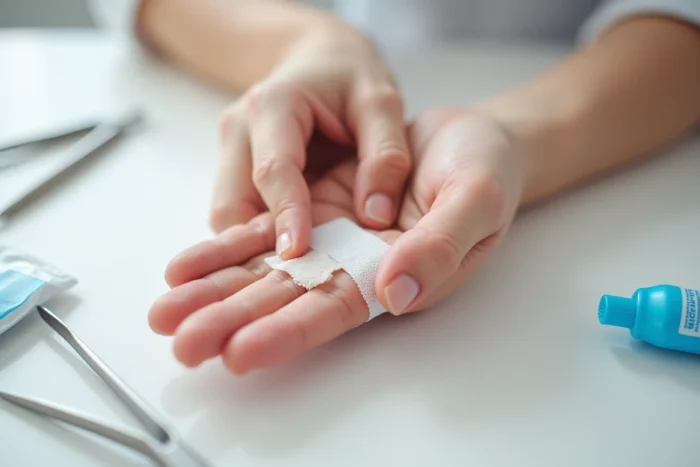
A non-adhesive dressing (like a greasy compress or silicone interface) placed on the wound, then secured with a bandage on the intact skin, protects without worsening the injuries.
Nail regrowth: intact or damaged matrix, two distinct scenarios
The nail matrix, the area located under the base of the nail (the lunula, that small white crescent), produces the cells that form the plate. When it is intact after a tearing, the nail normally regrows in a few months. A fingernail grows faster than a toenail, and the complete regrowth of a big toe takes significantly longer.
How can you tell if the matrix has been affected? A few signs should raise concern:
- Heavy and prolonged bleeding at the base of the nail, at the level of the lunula
- A visible deformation of the skin fold covering the matrix
- An irregular start to regrowth, with deep ridges, splitting, or a nail growing in an abnormal direction
- Persistent pain localized at the base and not on the nail bed
If any of these signs appear, medical advice (from a doctor or dermatologist) is necessary. A damaged matrix that is not addressed can lead to a permanently deformed nail, or even stop producing a nail altogether in the most severe cases. In some situations, surgical intervention can repair the matrix.
Follow-up in the following days: when healing goes off track
During the first two days, a pinkish ooze and moderate swelling are normal. However, some signals indicate that an infection is setting in or that healing is not proceeding correctly.
Redness that extends beyond the injured area, swelling that increases instead of decreasing, yellow-green pus, or even mild fever warrant a quick consultation. Changing the dressing every day allows for monitoring progress and gently cleaning the wound.
During the regrowth phase, protecting the toe or finger from repeated impacts remains the best way to achieve a regular nail. Shoes that are too tight on a healing toe can cause an ingrown nail or deform the new plate. For hands, a simple soft silicone thimble absorbs the micro-shocks of daily life.
A torn nail is frightening, but the body’s repair process is remarkably effective when given the right conditions: a clean wound, a protected moist environment, no aggressive products, and the patience to let the matrix do its job.