
Creatine monohydrate has a solid scientific basis, with several hundred studies confirming its ergogenic effect on high-intensity efforts. Probiotics, on the other hand, belong to a different realm: modulation of the microbiota, digestive tolerance, immunity. Combining the two seems logical on paper, but there is no clinical evidence demonstrating a direct synergistic effect on performance.
Muscle absorption of creatine: the underestimated role of insulin
The uptake of creatine by muscle fibers largely depends on an insulin signal. The work of Green et al. published in the American Journal of Physiology established that the co-ingestion of carbohydrates with creatine stimulates cellular transport and accelerates the saturation of phosphocreatine reserves.
In practice, this means that the most relevant cofactor for optimizing creatine supplementation is not a probiotic, but a source of carbohydrates, possibly combined with proteins. The insulin spike caused by this combination facilitates measurable muscle storage.
We recommend taking creatine monohydrate with a meal or snack containing carbohydrates (rice, oats, banana) rather than consuming it alone with just a glass of water. Adding whey or another protein source further enhances this mechanism. To explore the compatibility between these dietary supplements, you can discover So Sports’ articles on the subject.

Probiotics and creatine: why the combination lacks ergogenic evidence
All the scientific literature on the ergogenic effect of creatine, notably synthesized by the position stand of the International Society of Sports Nutrition (Kreider et al., JISSN 2017), is based on creatine monohydrate taken alone. No controlled trial has evaluated a creatine + probiotic formula to measure a gain in strength, hypertrophy, or power greater than creatine alone.
Some brands market combined formulas suggesting better bioavailability. This marketing discourse is not supported by any published data. Creatine monohydrate already has a very high bioavailability when taken orally. Adding a probiotic in the same supplement does not documentably change this parameter.
What probiotics actually do for athletes
Probiotics act in a different domain. Their interest lies in regulating the intestinal microbiota, reducing digestive disorders related to exercise, and supporting immunity during periods of intense training. These effects are well documented, but they remain highly dependent on the strains used and the individual context.
An endurance athlete prone to gastrointestinal issues during exercise may derive concrete benefits from a targeted probiotic regimen. This benefit is indirect: fewer missed sessions, better food tolerance, more consistent recovery. It does not translate into a measurable performance gain in the lab.
Timing of intake and digestive interactions between creatine and probiotics
If you wish to use both supplements, the timing question deserves attention. Creatine is ideally taken with a meal containing carbohydrates and proteins to maximize the insulin signal. Probiotics, on the other hand, are often recommended on an empty stomach or before a meal, depending on the strains.
- Creatine monohydrate: to be consumed with a carbohydrate-rich meal, preferably around training (before or after depending on the routine)
- Probiotics: to be taken away from creatine, ideally in the morning on an empty stomach or at bedtime, to avoid any interaction with the gastric acidity related to the meal
- Whey protein: compatible with creatine in the same post-workout shaker, which is the best-documented combination for muscle recovery
Separating the intake of creatine and probiotics throughout the day allows for optimal absorption conditions for each supplement. Mixing them in the same intake is not contraindicated, but does not provide any demonstrated advantage.
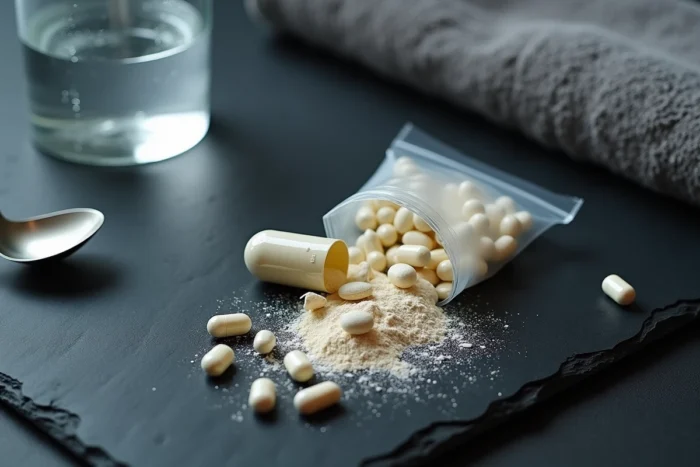
Which dietary supplements to actually combine with creatine for performance
Rather than seeking a hypothetical synergy with probiotics, we observe that the most solid scientific associations remain classic:
- Simple or complex carbohydrates: increase muscle uptake of creatine via insulin
- Proteins (whey, casein, plant proteins): contribute to muscle protein synthesis and enhance the insulin effect of carbohydrates
- Beta-alanine: acts on a distinct buffering mechanism (muscle carnosine), complementary to creatine for high-intensity efforts
- Caffeine: data is conflicting regarding possible interference with creatine, but most recent studies show no significant antagonism at usual dosages
Creatine monohydrate remains the best-validated dietary supplement for muscle mass and performance in short, intense efforts. Adding other supplements only makes sense if each addresses a specific and documented goal.
A word on basic nutrition
No stacking of supplements can replace a diet structured around energy, nutrient, and recovery needs. Before adding a probiotic or any other supplement to a routine that already includes creatine, it is more cost-effective to ensure that the intake of carbohydrates around training, daily proteins, and micronutrients meets actual needs.
The combination of probiotics and creatine is not dangerous, but it does not constitute a performance lever. Probiotics maintain their place among athletes facing recurrent digestive issues or immune fragility during heavy training periods. Creatine, on the other hand, stands on its own as long as the intake conditions (carbohydrates, hydration, regularity) are respected.