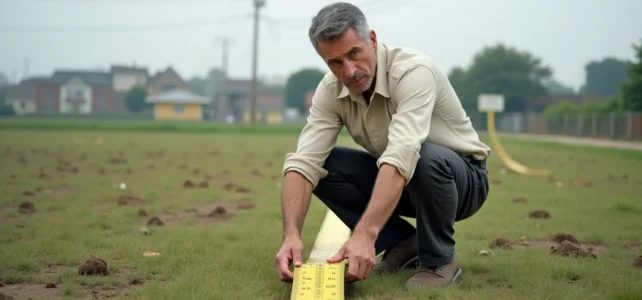
An are is equivalent to 100 square meters, which is the area of a square with sides of 10 meters. Therefore, talking about 6 ares refers to a plot of 600 m². This unit, inherited from the decimal metric system, remains the reference in notarial deeds and surveying documents to express the area of land.
Ground footprint and setbacks: what the PLU changes on 600 m²
The gross conversion (6 ares = 600 m²) does not indicate the actually usable area. Since the removal of the land occupation coefficient by the ALUR law, it is the PLU or PLUi regulations that locally set the implantation constraints. On a plot of 600 m², these rules weigh proportionally more than on a plot of 1,000 m².
The PLU generally imposes a setback from property boundaries and from the road. If the municipality requires a 3-meter setback on each side and 5 meters at the street front, the buildable area quickly shrinks. On a rectangular plot of 20 m × 30 m, these margins easily absorb a third of the total area.
To understand what 6 ares represents in usable area, it is necessary to cross the metric conversion with the applicable urban planning regulations for the plot. The allowed ground footprint, maximum heights, and parking obligations determine the buildable volume much more than the gross figure of 600 m².
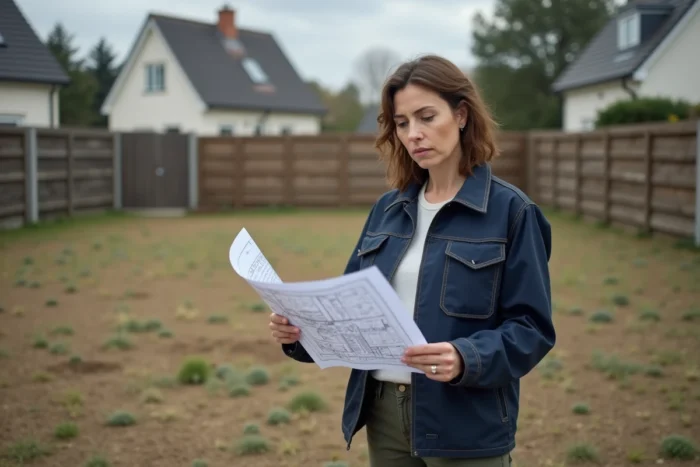
6 ares of land: visualizing 600 m² with concrete references
An abstract number becomes understandable as soon as it is related to familiar areas. A football field measures about 7,000 m². A plot of 600 m² thus represents less than one-tenth of this rectangle.
Another reference: a tennis court is about 260 m². Six ares is a little more than two tennis courts placed end to end. In a recent subdivision, 600 m² corresponds to a plot of average size, with a modest garden around a single-story house.
According to data from the SDES, the median area of land for new construction has decreased by 18% over ten years nationwide. Plots of around 600 m² are now much more common than they were a decade ago. This decline reflects land pressure in tight areas and the desire of local authorities to limit urban sprawl.
Conversion are, centiare, hectare: situating 6 ares in the area scale
The are fits into a simple decimal scale, but confusion between units remains frequent in real estate listings.
- The centiare (ca) is worth 1 m². Therefore, six ares contain 600 centiares. This unit is used to express fractions of an are in sales deeds, for example “6 a 42 ca” for 642 m².
- The hectare (ha) is worth 100 ares, or 10,000 m². A plot of 6 ares represents 0.06 hectare. The hectare is the preferred unit for agricultural operations or large estates.
- The square meter remains the unit of the international system. In French real estate practice, one converts from ares to m² by multiplying by 100, and conversely by dividing by 100.
Remembering this hierarchy (1 ha = 100 a = 10,000 m²) avoids reading errors on a cadastral survey or a surveyor’s document.
Common trap in listings
Some listings mix ares and centiares without a clear separator. “6.50 ares” refers to 650 m², but “6 ares 50” can be mistakenly interpreted as 6,050 m². Checking the unit and notation before comparing two plots avoids considerable discrepancies in area.
Buildability of a 600 m² plot: what the ALUR law changed
Before 2014, the COS set a national ratio between the authorized floor area and the area of the land. On 600 m² with a COS of 0.3, the maximum floor area was 180 m². The ALUR law removed this mechanism.
Now, there is no national minimum surface threshold that conditions the buildability of a plot. It is the local PLU rules (ground footprint, height, prospect) that frame the project. In some areas, this removal allows for denser constructions on 600 m² than before. In others, the municipal regulations impose stricter constraints than the former COS.
For a plot of 6 ares intended for a single-family home, the process involves consulting the operational urban planning certificate. This document, issued by the town hall, indicates whether the land is buildable and under what conditions. It specifies the setback rules, maximum height, and any easements.
Land area and construction project: deciding on 6 ares
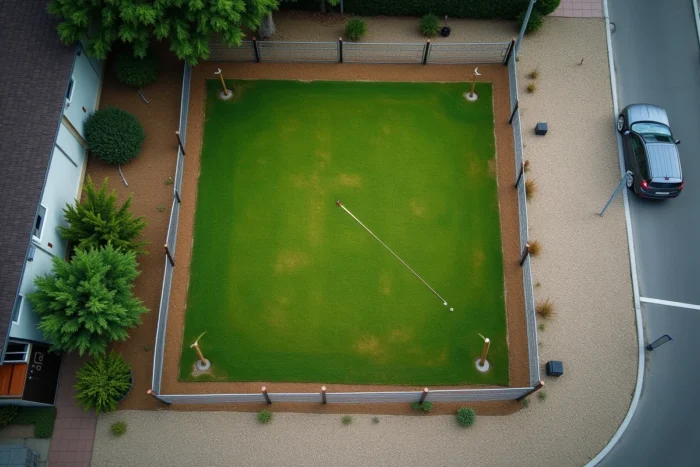
On 600 m², architectural choice directly affects outdoor comfort. A single-story house with a footprint of 100 m² leaves about 500 m² of garden before setbacks. A two-story house with a footprint of 70 m² frees up more land, but the height constraints of the PLU may limit this option.
- A single-story house maximizes accessibility but consumes more ground footprint.
- A two-story construction preserves the garden, provided that the allowed height permits it.
- The installation of a garage or garden shed further reduces the available area and counts towards the ground footprint calculation.
The shape of the plot is as important as its area. A 600 m² strip-shaped plot (15 m × 40 m) does not offer the same possibilities as a square plot with sides of 24.5 m. Lateral setbacks penalize narrow plots more.
Six ares constitute a sufficient area to accommodate a single-family home with a functional outdoor space, provided that the urban planning regulations are checked before any purchasing decision. The urban planning certificate remains the reference document to transform 600 m² into a realistic project.