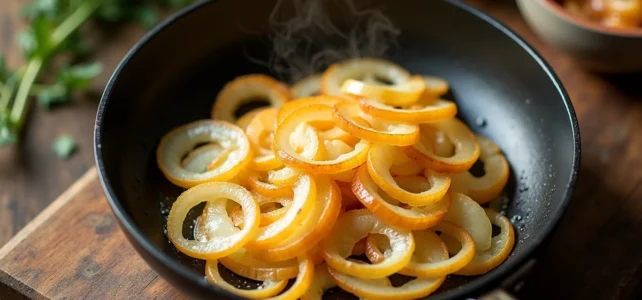
Sauté onions without fat raises a specific technical question: how to achieve satisfactory color and flavor when there is neither oil nor butter to conduct heat in the pan? The answer lies less in a miracle ingredient than in a series of choices regarding the heat, the moisture liquid, and the type of onion used.
Cooking onions dry: what really happens in the pan
When an onion comes into contact with a hot surface without fat, the water it naturally contains evaporates. This evaporation phase absorbs a significant amount of thermal energy, which slows down the browning.
If the heat is too high, the water escapes quickly, the natural sugars in the onion come into direct contact with the burning metal and carbonize. The result is bitter, dry, and the texture resembles more of a barbecue waste than a melting condiment.
The challenge of cooking without fat is therefore not to replace oil with something else, but to manage the speed at which water leaves the onion. The more you slow down this evaporation, the more time the sugars have to caramelize gently instead of burning. A detailed guide allows you to sauté onions on Double Portion by following this progressive cooking logic.
In practice, this means keeping a medium to low heat from start to finish. Turning up the flame to “speed up” cooking is the reflex that sabotages everything. Patience replaces butter here.
Yellow, red, or white onions: the choice changes the result without fat
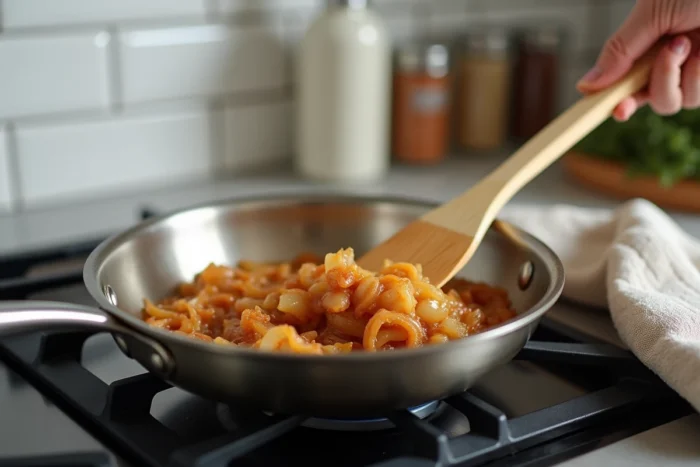
Not all onions react the same way to cooking without fat. Yellow onions become sweeter and more melting when cooked, making them the best compromise for this type of preparation. Their natural sugar content compensates for the absence of fat by providing tenderness and a natural golden color.
Red onions, on the other hand, are more suited for raw or marinated dishes. Cooked dry, they lose their color and take on an unappetizing grayish hue. Their flavor, initially sharper, does not mellow as well as that of yellow onions.
White onions fall somewhere in between. They release a lot of water, which can help kickstart the cooking process, but their flavor remains quite neutral once cooked. If you’re looking for taste without adding fat, yellow onion remains the most consistent choice.
Moistening technique: water, broth, or vinegar in the pan
The technique that makes a difference when cooking onions without oil or butter is moistening during cooking. The principle is simple: when the onions start to stick to the bottom of the pan, a small amount of liquid is added to lift the fond without stopping the caramelization.
Which liquid to choose to moisten the onions
- Water works, but adds nothing in terms of flavor. It only serves to prevent the onions from burning and to restart the cooking.
- Vegetable broth adds depth. It contains salt and herbs that concentrate as they evaporate, compensating for the absence of fat in terms of taste.
- Vinegar (cider or balsamic) adds acidity that balances the sweetness of the caramelized onion. A spoonful is enough. Too much vinegar makes the result sour and masks the desired sweetness.
Moistening is done in small amounts, one to two tablespoons at a time. The goal is not to drown the onions in liquid, but to lift the fond stuck to the bottom of the pan and reincorporate it into the preparation.
This action can be repeated several times during cooking. Each pass creates a new layer of flavor. This is what allows you to achieve melting and colored onions without any fat.
Cooking onions with other vegetables that release water
An effective variation is not to cook the onions alone. By pairing them from the start with vegetables that naturally release juice (mushrooms, zucchini, tomatoes), you create a humid environment in the pan without adding anything.
Mushrooms are particularly useful in this logic. They release a lot of water at the beginning of cooking, which prevents the onions from sticking. Once this water evaporates, the two ingredients begin to brown together.
This approach works best in a non-stick pan or in thick stainless steel. Thin aluminum pans create hot spots that lead to uneven cooking, with burnt pieces next to still raw ones.
The role of herbs in cooking without fat
Garlic, thyme, bay leaves, or rosemary added during cooking compensate for the absence of fat in terms of aroma. Fat has this often-overlooked function: it dissolves and carries aromatic compounds. Without it, the herbs must be in direct contact with the onions to release their fragrance.
Finely chopping the garlic and mixing it with the onions rather than leaving it in whole pieces significantly improves flavor diffusion. Salt, added at the beginning of cooking, accelerates the release of water from the onions and helps kickstart the dry cooking process.
Successfully caramelizing onions without fat: the time factor
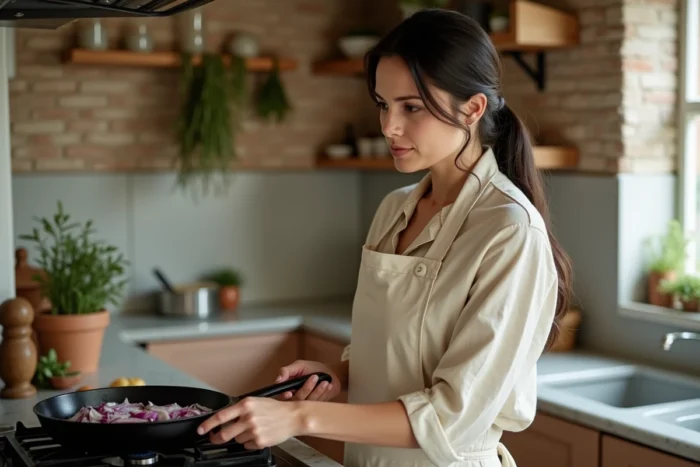
Caramelizing without fat takes longer than traditional cooking. Field reports vary on this point, but you should expect it to take significantly longer than with butter or oil to achieve a comparable result.
This extra time is not a flaw in the method. It corresponds to a gentler cooking process, which preserves the delicate aromas of the onion instead of destroying them with excess heat. The caramelization achieved is often more even and less bitter than that done over high heat with fat.
- Stir regularly, every two to three minutes, to prevent the onions from sticking to one side.
- Do not cover the pan continuously: trapped moisture prevents browning. Cover occasionally to soften, uncover to brown.
- Cut the onions into thin, even slices for uniform cooking. Pieces of different sizes lead to a mix of burnt and raw.
Cooking onions without fat relies on three levers: a low heat maintained from start to finish, controlled moistening to lift the fond, and the choice of a yellow onion whose natural sugars do the work of caramelization. The rest is a matter of patience and the right pan.