
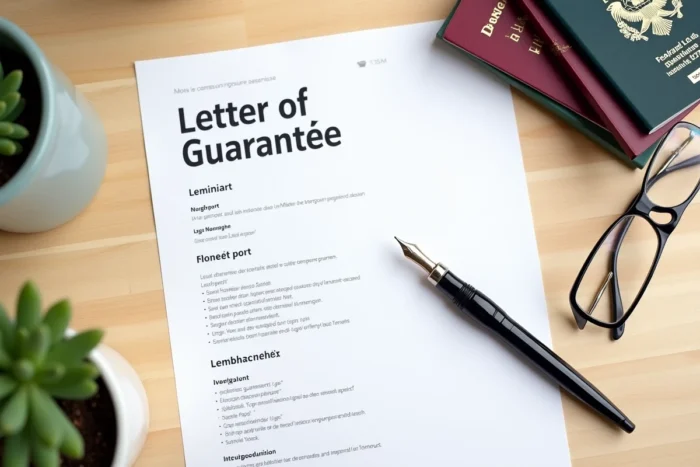
A guarantor letter drafted for a French lease does not work as is if the property is located in Switzerland, Belgium, or Spain. The law applicable to the guarantee is that of the country where the rented property is located, even when the guarantor resides in another country. This principle conditions the choice of the model, the language of writing, the mandatory mentions, and the form of the commitment.
Law of the country of the property: the criterion that determines the entire model
Before looking for a standard model, the first question concerns the applicable law. For a property located in France, it is the law of July 6, 1989, that governs residential leases and, by extension, the guarantee act. PAP reminds us that this rule applies even if the guarantor lives abroad or has a poor command of French.
Specifically, a guarantor residing in the United Kingdom who guarantees a Parisian apartment must produce a document compliant with French law. The mandatory mentions (amount of rent, duration of the commitment, identification of the landlord and tenant) remain those of the French Civil Code. An adapted guarantor letter model for international leases incorporates these requirements while taking into account the cross-border situation.
Conversely, for a property in Switzerland, the rules change radically. Swiss law allows for bank guarantees via a blocked rental guarantee account (offered by institutions like UBS), making personal guarantor letters less common. In Belgium, guarantees are also governed by specific rules, distinct from French law.
Identifying the country of the property before choosing a model avoids producing a document that is legally unusable.

Mandatory mentions in an international guarantee act
Once the applicable law is identified, the content of the letter must comply with specific mentions. For a lease subject to French law, the guarantee act must include several elements framed by law.
- The complete identity of the guarantor (name, first name, address, including if this address is abroad) and that of the tenant
- The address of the rented property, the amount of rent and charges, as well as the conditions for rent revision
- The nature of the commitment: simple guarantee or joint guarantee, a distinction that changes the landlord’s rights in case of non-payment
- The duration of the commitment and the conditions for termination, which must be explicit
- The mention that the guarantor is aware of the maximum amount of their commitment, including charges and penalties
In the case of a joint guarantee, the landlord can claim directly from the guarantor from the first unpaid rent, without first pursuing the tenant. Most French landlords require this form. Therefore, the chosen model must clearly specify the type of guarantee retained.
For a lease in another country, these mentions vary. A French model applied to a Belgian or Spanish lease will be incomplete or contain clauses without local legal value.
Language of writing and sworn translation
The question of language arises systematically in an international context. An English-speaking guarantor who signs a document in French without understanding it could contest the validity of their commitment. Conversely, a French landlord may refuse a document written only in English.
The safest practice is to produce a bilingual document or one accompanied by a sworn translation. The version in the language of the applicable law (that of the country of the property) prevails in case of dispute. The translation allows the guarantor to understand the exact scope of their commitment.
For a French lease, the simulator on service-public.gouv.fr generates a guarantee act in French with mentions compliant with current law. This document can serve as a basis, provided that a translation is added if the guarantor does not read French.
Legalization and apostille
Some landlords or agencies require that the signature of the foreign guarantor be legalized or apostilled. The apostille (Hague Convention) certifies the authenticity of a public document in another signatory country. This requirement is not systematic, but it strengthens the admissibility of the letter, especially when the guarantor cannot travel to sign in front of the landlord.
Alternatives to a physical guarantor for a lease abroad
Finding a guarantor whose file will be accepted by a foreign landlord remains complicated. Income earned in a third country is difficult to verify, and supporting documents (tax notices, pay slips) do not have the same format from one country to another.
Several mechanisms circumvent this difficulty:
- Visale (Action Logement) covers leases located in France for young people under 30 and employees in mobility, without nationality conditions for the tenant
- Private guarantee organizations (Garantme, Unkle, or equivalents) accept international profiles and issue a certificate directly acceptable by the French landlord
- The bank guarantee, common in Switzerland and some Nordic countries, replaces the guarantor letter with a blocked account at a bank
These solutions prevent the guarantor from having to produce income documents in a foreign format that the landlord may not be able to verify. They also simplify the issues of language and legalization.
Supporting documents from the foreign guarantor: what the landlord can request
The decree of November 5, 2015, regulates the list of documents that a landlord can require from a guarantor in France. For a guarantor residing abroad, the same categories apply: identity document, proof of residence, proof of professional activity, and proof of income.
The difficulty lies in the equivalence of documents. A British tax notice or a Canadian income statement does not have the same form as a French tax notice. The landlord cannot require a document that does not exist in the guarantor’s country, but they can request a reasonable equivalent.
Including an explanatory note identifying each document and its French equivalent facilitates the acceptance of the file. This approach, rarely mentioned in standard models, makes the difference between a rejected file and a file processed quickly.
Choosing the right guarantor letter model for an international lease therefore relies less on the form of the letter than on three preliminary checks: the applicable law, the acceptable language, and the guarantor’s ability to provide documents readable by the local landlord.